Written by Amrit, who has spent over a decade working across commercial AC and compliance.
As a facilities manager or landlord, you know you have a legal duty to prevent refrigerant from leaking from your air conditioning. This leads to a common question we hear from clients: 'Is the mandatory F-Gas leak check the same as getting the system serviced?'
It's a fair question, especially when trying to manage a tight maintenance budget. Understanding the distinction is vital. One is a straightforward compliance task that keeps you legal, whilst the other is a comprehensive engineering task that keeps your system reliable and efficient. Confusing the two can lead to unexpected failures, higher energy bills, and a false sense of security.
No, an F-Gas leak check is not the same as a full air conditioning maintenance service. They are two different jobs with different objectives.
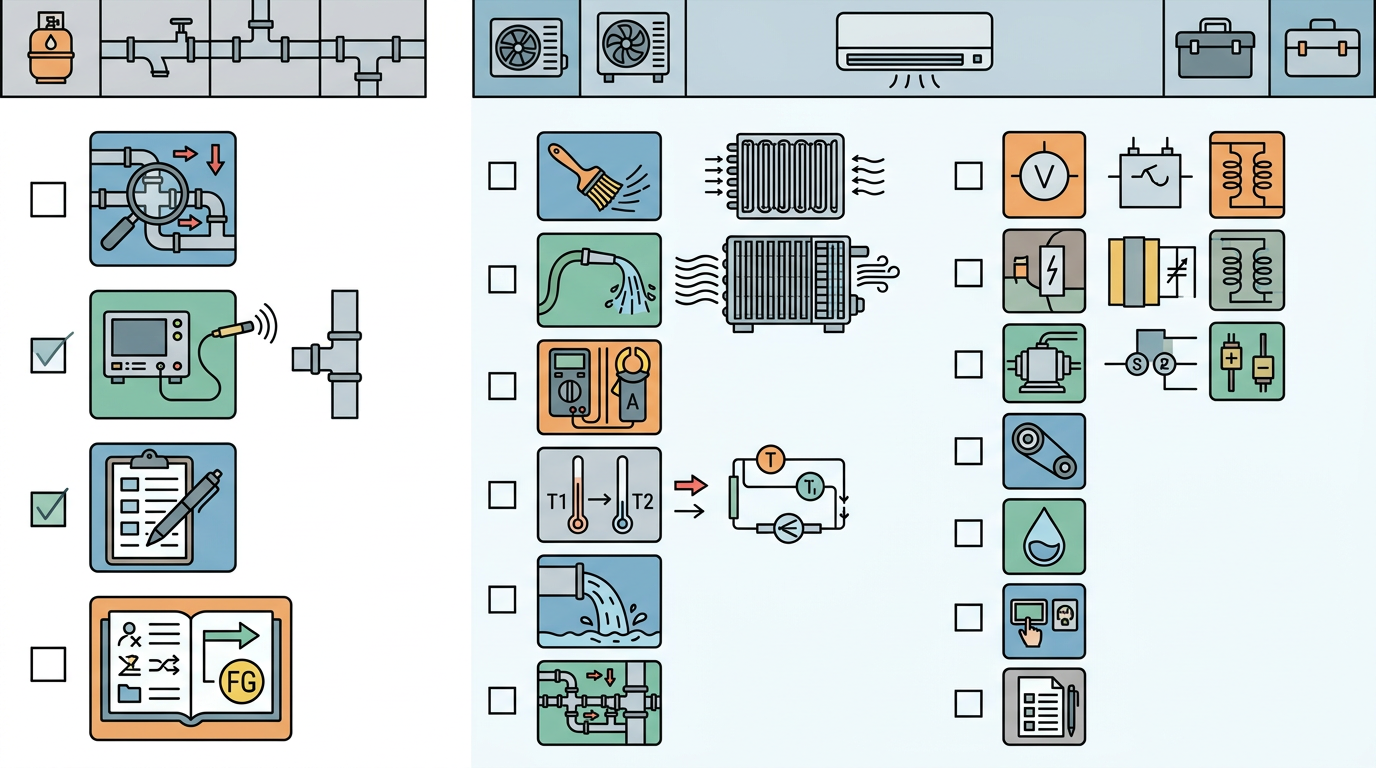
A statutory F-Gas leak check is a pass-or-fail test designed solely to find and log refrigerant leaks, as required by UK law. A full maintenance service is a proactive, preventative process that includes cleaning, testing, and optimisation. Its goal is to improve energy efficiency, prevent breakdowns, and extend the lifespan of the equipment. A proper maintenance visit will always include an F-Gas leak check, but a leak check alone contains none of the elements of a maintenance service.
What is a mandatory f-gas leak check?
The primary purpose of an F-Gas leak check is environmental compliance. It is dictated by the F-Gas Regulation (EC) 517/2014, which mandates that systems containing a certain volume of fluorinated greenhouse gases (refrigerants) must be periodically checked for leaks.
During this visit, a REFCOM-certified engineer will use a calibrated electronic leak detector to systematically inspect all the susceptible parts of a system: pipe joints, valves, service ports, and coils. The process is essentially a hunt for escaping refrigerant gas.
The outcome is binary. If no leak is found, the system passes and the engineer updates your F-Gas logbook to prove you've met your legal obligation. If a leak is detected, it must be repaired as soon as possible, and the system re-tested to confirm the repair was successful before it can be refilled or put back into service. The check does nothing to improve the system's performance.
What happens during a full maintenance service?
A full maintenance service, often called a PPM (Planned Preventative Maintenance) visit, is focused on the mechanical and electrical health of your HVAC system. While it always includes a statutory F-Gas leak check, that is just one small part of a much larger job.
A proper service involves a long list of checks and actions, including:
• Thoroughly cleaning the indoor and outdoor unit coils.
• Removing and cleaning filters.
• Checking and tightening electrical connections to prevent fire risk.
• Testing safety devices and controls.
• Measuring system operating pressures and temperatures.
• Checking and clearing condensate drains to prevent water leaks and property damage.
• Inspecting fan motors, bearings, and belts for wear and tear.
The engineer provides a detailed service report showing the condition of the unit, all the readings taken, and any advisories for upcoming repairs. The goal is to leave the system running as close to its original design specification as possible.
Why isn't a leak check enough on its own?
Relying solely on F-Gas leak checks is a false economy. It is a purely reactive measure that only confirms whether your system is already failing in its primary purpose: containing refrigerant.
This approach completely ignores the two biggest factors in day-to-day operations: energy consumption and reliability. Dirty coils or a blocked filter can force the system's compressor to work much harder, dramatically increasing your electricity bills and hastening its demise. A clogged condensate drain can cause a ceiling leak and expensive water damage, something a leak check would never spot.
Think of it like owning a car. The annual MOT is the legal minimum to say it's roadworthy today, but it doesn't involve changing the oil, checking the brakes for wear, or rotating the tyres. The MOT is your leak check; the full dealer service is your proper maintenance. One keeps you legal, the other keeps the car from breaking down on the motorway.
How we handle this at Accutemp
We don't see these as separate activities. For us, a mandatory F-Gas leak check is a non-negotiable part of every single maintenance visit we perform. It is integrated into our digital service report, which you receive after every visit, providing a clear audit trail for your F-Gas logbook and ISO 14001 compliance.
Our standard PPM checklist for a split system has over 40 individual points. One of the most important is #17: 'Check and record superheat and subcooling readings'. These two temperature and pressure calculations tell our engineer instantly if the refrigerant charge is right and the system is operating efficiently. An incorrect reading is the single best early indicator of a slow leak or an impending expansion valve failure, allowing us to spot a problem weeks or months before it causes a catastrophic breakdown. A simple leak-check-only visit provides none of this insight.
What to do next
Treating a compliance task as a substitute for proper engineering maintenance is one of the most common and costly mistakes we see. It risks poor performance, high energy costs, and premature equipment failure.
If your current provider only talks about F-Gas leak checks, it may be time to review your maintenance schedule. A structured PPM plan from a REFCOM-certified organisation is the correct way to manage valuable HVAC assets, ensuring both compliance and reliability.