Written by Amrit, who has spent over a decade working across commercial AC and compliance.
A common point of confusion for facilities managers is the paperwork that comes with air conditioning. You get a report from the engineer after a service visit, but you're also told you need an F-Gas logbook. Are they the same thing? Do you need both?
Understanding the distinction is not just about good record-keeping. One is a record of service, whilst the other is a legal requirement under UK F-Gas Regulations. Getting it wrong can lead to serious penalties from the Environment Agency during an audit.
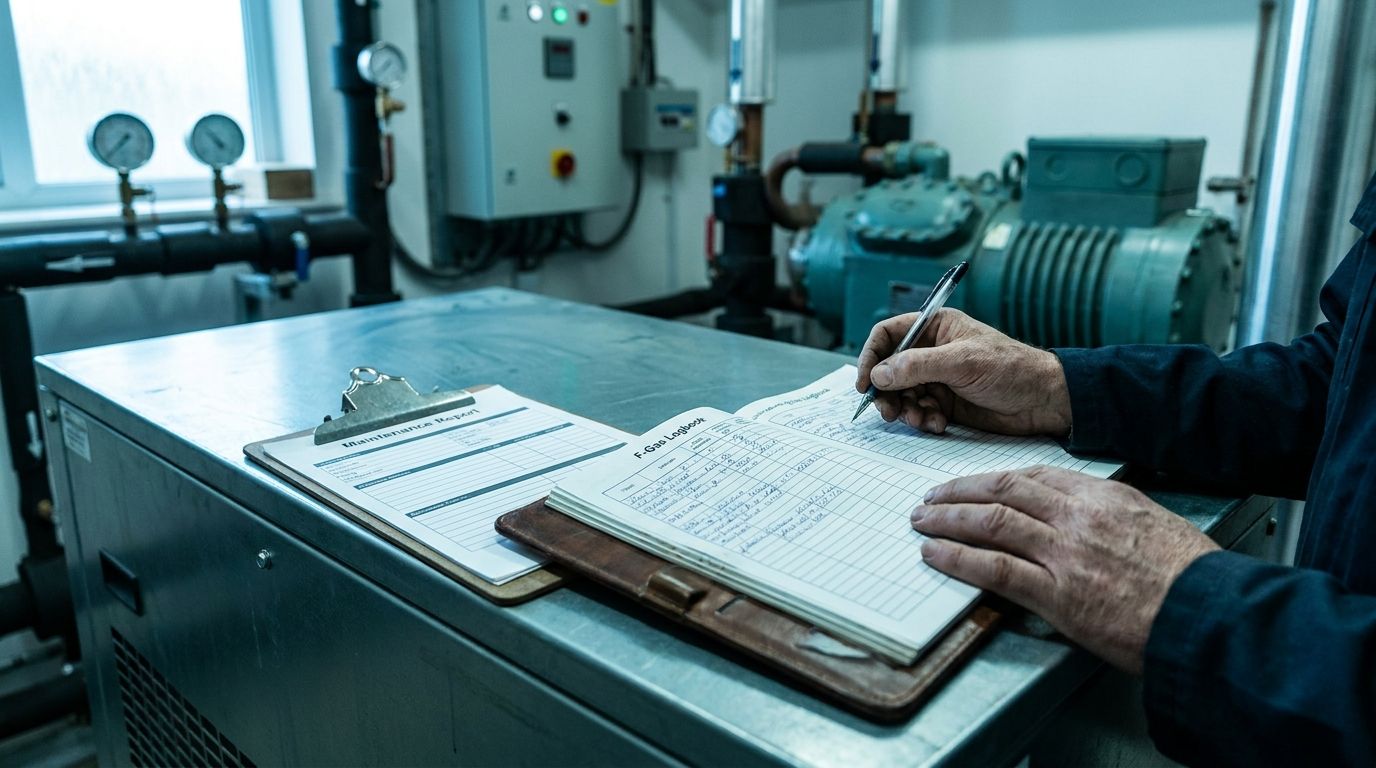
No, they are different documents for different purposes. An F-Gas logbook is the legally mandated record of all refrigerant gas stored in, added to, or removed from your systems. A maintenance report is the engineer's record of the specific checks, tests, and tasks performed during a planned service or a reactive call-out.
The logbook tracks the refrigerant; the maintenance report tracks the work done on the equipment. Your engineering partner should provide you with both, but the legal responsibility for maintaining the F-Gas log ultimately rests with you, the operator of the equipment.
What is an F-Gas Logbook for?
The F-Gas logbook is a compliance document. It exists to prove you are managing your refrigerants responsibly. It applies to stationary equipment containing fluorinated greenhouse gases (F-gases) equivalent to 5 tonnes of CO2 or more.
Each time an engineer works on the refrigerant circuit, they must update the log. This includes the quantity and type of F-gas added during a recharge, the amount recovered during decommissioning, and the details of the certified engineer and company (including their REFCOM number) who performed the work. This creates an unbroken chain of custody for the refrigerant.
What should be in a maintenance report?
A maintenance report, or service sheet, is your proof of work. It demonstrates that you are properly maintaining the asset, which is crucial for safety, efficiency, and warranty purposes. Unlike the F-Gas log, its contents are not legally prescribed, but a professional report should be detailed.
It should include operational data like running pressures and temperatures, electrical readings, notes on the condition of filters and coils, confirmation of drain clearance, and a summary of any remedial actions taken or recommended. This is the document that tells you the actual health of your system, not just its refrigerant levels.
How we handle this at Accutemp
We see it all the time: a crucial, legally required F-Gas logbook exists only as a tatty piece of paper stuffed in a folder in a plant room, if it can be found at all. This is a massive liability for any commercial operator. If an Environment Agency inspector turns up and the book is missing or has coffee stains over the last entry, the responsibility falls on the client.
That's why we operate a fully digital system. After every relevant job, our engineers immediately update your site's F-Gas log on our system, which you can access any time. Our detailed service reports are also delivered digitally the same day. This means your compliance and maintenance records are always synchronised, secure, and ready for any audit.
What to do next
Check your current records. Do you have a distinct, up-to-date F-Gas log for all qualifying assets? Are your maintenance reports detailed enough to demonstrate proper care of your equipment?
If you are unsure about your legal obligations or find your current records lacking, it's wise to arrange a review. Ensuring your paperwork is in order provides peace of mind and protects your organisation from compliance risks.