Written by Amrit, who has spent over a decade working across commercial AC and compliance.
If you manage a commercial property, you have probably heard talk of changing F-Gas regulations. It's often unclear what these changes actually mean for the chillers, VRF systems, and split units already installed in your buildings. This is not just a paperwork exercise for your logbook; it has direct financial and operational consequences for your HVAC assets.
The core question is whether your existing equipment is still viable long-term. Understanding the rules impacts your budget for repairs, your strategy for replacement, and your building's overall compliance and operational risk.
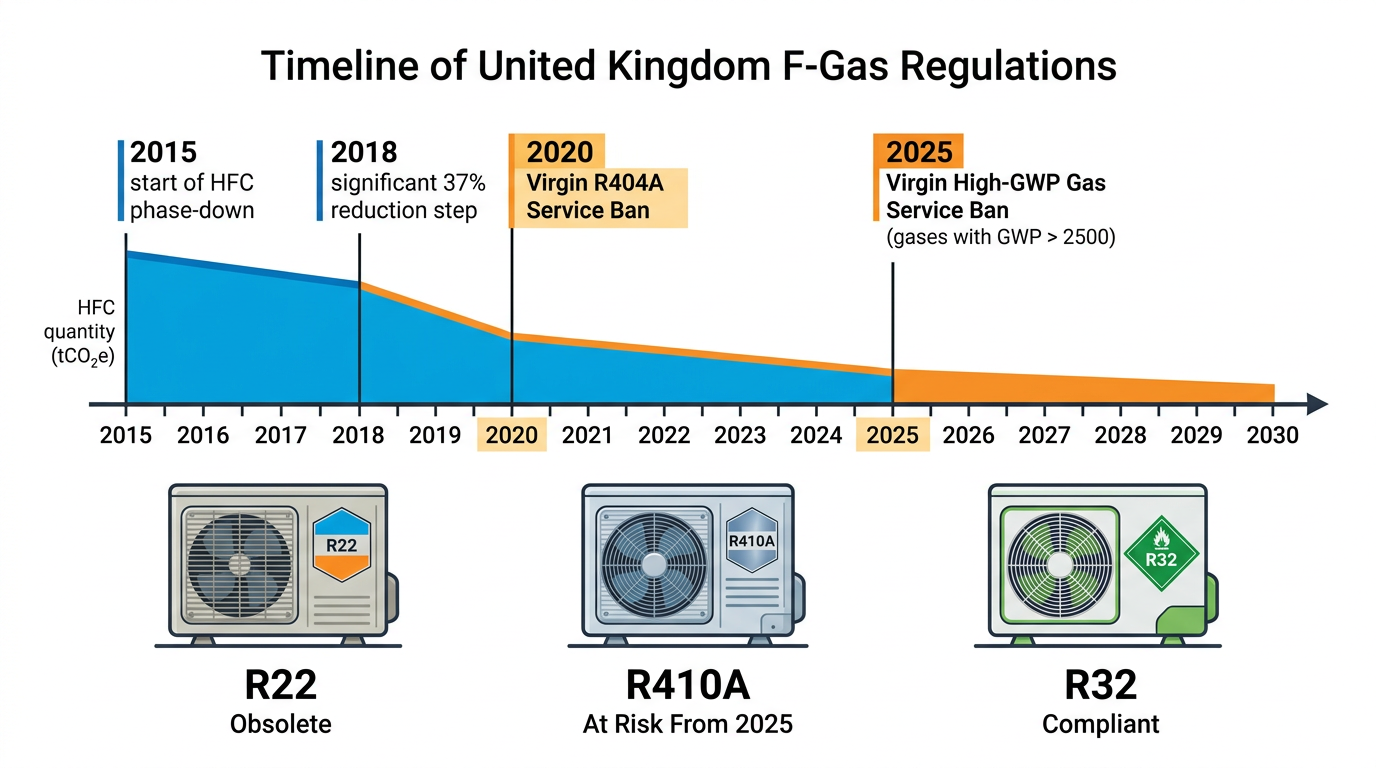
The regulations are designed to 'phase down' the use of refrigerants with a high Global Warming Potential (GWP). For most commercial systems installed in the last 15 years, the main refrigerant of concern is R410A.
From 1 January 2025, a ban comes into force on using 'virgin' (newly manufactured) refrigerants with a GWP of 750 or more to service and fill refrigeration equipment with a charge size of 40 tonnes of CO2 equivalent (which for R410A is about 19kg). Whilst R410A's GWP is 2,088, this specific ban is for refrigeration, but the market-wide squeeze on all higher-GWP gases is the real issue. The availability of all virgin high-GWP refrigerants, including R410A, is being drastically reduced. This makes any repair requiring a significant refrigerant top-up extremely expensive, difficult, and, in some cases, unviable. It effectively shortens the economic life of your equipment.
What is global warming potential (GWP) and why does it matter?
Global Warming Potential is a measure of how much heat a greenhouse gas traps in the atmosphere over a specific time, relative to carbon dioxide (CO2). Carbon dioxide has a GWP of 1. Older refrigerants like R404A have a GWP of 3,922, which is why their use in servicing has been banned since 2020.
The workhorse refrigerant for most systems installed since then has been R410A, which has a GWP of 2,088. Whilst this is an improvement on R404A, it is still considered very high. Modern systems now use refrigerants like R32, which has a much lower GWP of 675.
The regulations use a quota system that progressively reduces the total amount of GWP that can be sold on the market. This creates commercial pressure that drives up the price and reduces the availability of high-GWP gases like R410A, regardless of specific service bans. In short, the refrigerant your system uses is now a primary factor in its lifetime running cost and serviceability.
Does this mean i have to replace my r410a system right away?
No. You are not required to rip out a perfectly functional R410A system. The regulations do not ban the *use* of these systems. The problem arises when the system develops a leak and requires a refrigerant recharge.
If a leak occurs, you cannot simply top it up with new R410A if it falls under certain bans, and even if it doesn't, the cost and scarcity of the gas are major issues. The only alternative is to use 'reclaimed' refrigerant, which is gas recovered from other systems and reprocessed. However, the supply of reclaimed R410A is finite, and its price is volatile and high. It is not a sustainable long-term service strategy.
A major leak on an R410A system post-2025 will force a difficult decision: is a very expensive repair using reclaimed gas worth it, or is the capital better put towards a new, compliant, and more efficient R32 system? For many facilities managers, this regulation turns a potential repair into a forced replacement.
What are my options if my r410a system fails?
Your first decision is repair versus replace. As mentioned, a repair involving a significant gas recharge is often uneconomical. You are paying a premium to service a system that is already becoming obsolete.
Some contractors might suggest 'drop-in' replacement refrigerants. These are gases designed to work in systems built for R410A. This approach is full of risk. At best, you will see a drop in system performance and efficiency. At worst, using a gas not approved by the original manufacturer can damage components like the compressor and will almost certainly void any remaining warranty. It is rarely a viable professional solution.
The most strategically sound option is to plan for replacement. A new system using R32 is not only compliant with current F-Gas regulations but is also significantly more energy-efficient, reducing your running costs. Planning for this replacement on a schedule you control is far better than being forced into an emergency replacement when a system fails at a critical time.
How we handle this at Accutemp
When we bring a new commercial site under our management, our first step after the initial safety checks is to build a complete asset and F-Gas register. This isn't a simple tick-box exercise for us. A key part of our audit is to flag every single system running on R410A or any other older refrigerant.
For each of these flagged units, we record the exact refrigerant charge in kilograms. This detail is critical. We then generate a 'risk report' for the client's entire HVAC estate. We classify systems into three tiers: low-risk (e.g., modern R32 units), medium-risk (serviceable R410A units with no leak history), and high-risk (ageing R410A systems or any unit with a history of leaks).
This report gives the facilities manager a clear, data-driven view of their future liabilities. It allows them to move from a reactive footing to proactive capital expenditure planning. Our REFCOM-certified engineers can then provide a realistic lifecycle plan for each asset, ensuring compliance and preventing budget blowouts from unexpected failures.
What to do next
Your immediate action is to know what you have. Your F-Gas logbook or asset register should list every air conditioning unit and the type and quantity of refrigerant it contains. If this information is missing or incomplete, your organisation is already non-compliant and at risk.
Once you have this data, identify all systems using R410A. Assess their age, condition, and service history. This will form the basis of a sensible, long-term plan for maintenance, repair, and eventual replacement, putting you back in control.