Written by James, who carries out maintenance visits and diagnostics day to day.
One of the most common questions we get from facilities managers is, 'How often do my commercial air conditioning units actually need servicing?'. It’s a reasonable question, but a crucial one to get right. Approaching it with a domestic mindset of 'once a year before summer' can lead to serious problems in a commercial setting.
Getting the frequency wrong isn't just about risking a breakdown on the hottest day of the year. It can mean failing to meet your legal F-Gas obligations, running up huge energy bills from inefficient equipment, and shortening the life of what is a significant capital asset. The answer dictates your planned preventative maintenance (PPM) schedule, your budget, and your legal compliance.
There is no single correct answer. The service frequency for commercial air conditioning depends on three factors: legal F-Gas leak check requirements, the unit's operating environment, and the manufacturer's recommendations.
As a general baseline, most standard commercial systems in office or retail environments benefit from bi-annual servicing (twice a year). However, for systems with a large refrigerant charge, the legal minimum for F-Gas leak checks might be quarterly. Conversely, for a system in a harsh environment like a commercial kitchen, quarterly servicing is often necessary for operational reliability, regardless of the F-Gas rules.
What are the legal f-gas requirements?
Your first consideration is the law. The F-Gas Regulations are not about general maintenance; they mandate a specific frequency for *leak checks* on systems containing fluorinated greenhouse gases. Because these checks are performed by a qualified engineer during a service visit, they effectively set the minimum number of visits per year.
This frequency is determined by the amount of refrigerant in the system, measured in tonnes of CO2 equivalent (CO2e).
• 5 to 50 tonnes CO2e: Requires a leak check at least every 12 months.
• 50 to 500 tonnes CO2e: Requires a leak check at least every 6 months (bi-annually).
• Over 500 tonnes CO2e: Requires a leak check at least every 3 months (quarterly).
An F-Gas certified engineer can calculate the CO2e for your systems. It’s important to remember this is the legal floor, not a recommendation for optimal performance. Simply meeting your F-Gas date is not the same as properly maintaining the equipment.
How does my building's environment affect service frequency?
The second major factor is where the units are and how hard they work. A unit's filters, coils, and fans will get clogged and worn at different rates depending on the air quality and run time.
We typically group environments into two categories:
• **Harsh or Critical Environments:** This includes commercial kitchens, restaurant serveries, gyms, server rooms, and industrial sites. Air laden with grease, dust, and particulates, or systems that run 24/7 for critical cooling, require more attention. For these, we almost always recommend quarterly servicing (four times a year) to keep coils clean, check components under heavy load, and prevent failures.
• **Standard Environments:** This covers the majority of office buildings, retail spaces, and meeting rooms. For these, a bi-annual service schedule is the accepted best practice. This typically involves one visit in the spring to prepare for the cooling season and another in the autumn to check for issues after a summer of hard work and prepare for any heating functions.
What if i have modern VRV or VRF systems?
Variable Refrigerant Volume (VRV) or Variable Refrigerant Flow (VRF) systems are sophisticated and efficient, but this complexity does not remove the need for regular servicing. Whilst their advanced controllers can provide valuable diagnostic data, they cannot replace physical inspection.
These systems often have extensive pipework runs and dozens of connections, increasing the number of potential failure points. Furthermore, manufacturers like Daikin and Mitsubishi often stipulate a bi-annual service schedule carried out by a certified engineer as a condition of their 5 or 7-year warranties. Skipping a planned service could leave you without manufacturer support in the event of a major component failure.
How we handle service schedules at Accutemp
We build every Planned Preventative Maintenance (PPM) schedule from the ground up, based on a physical site survey. There is no 'standard' package, because no two buildings are the same.
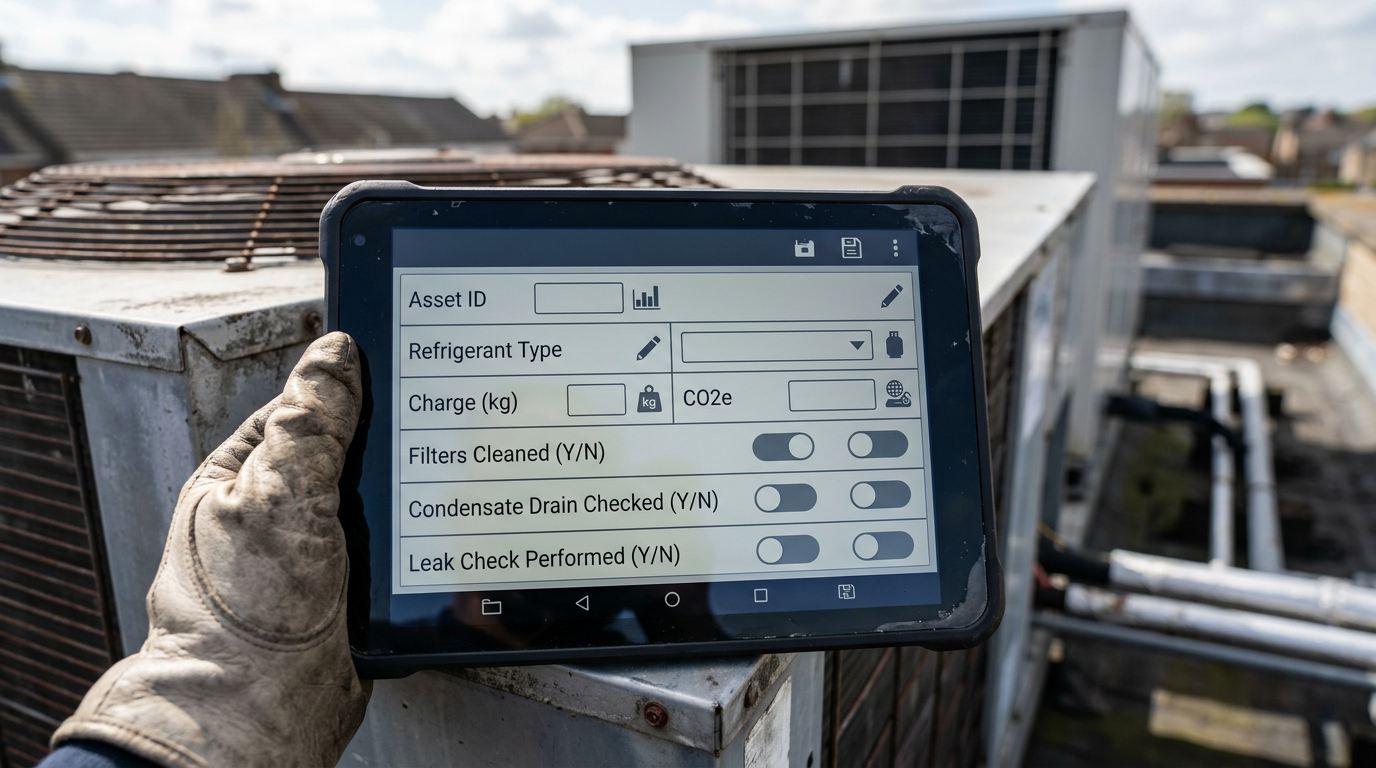
The first thing our engineers do on a new site is create a detailed F-Gas asset register. For every single indoor and outdoor unit, we log the make, model, location, refrigerant type, and the exact refrigerant charge in kilograms. From this, we calculate the CO2e value for each system, which defines your legal obligations under the F-Gas regulations. This is the foundation of a compliant and effective PPM plan and ensures your records are audit-ready for bodies like the Environment Agency.
Only then do we propose a schedule. We’ll map the legal minimums from the CO2e calculations against the reality of your site—recommending six-monthly visits for your main office VRV but perhaps quarterly for the server room units and the system cooling your factory floor. This ensures you are compliant, efficient, and not paying for unnecessary visits.
What to do next
A proper PPM schedule is your best defence against unplanned downtime, high energy costs, and compliance headaches. It should be based on a complete asset list and a clear understanding of your legal duties.
If you are managing a building without a clear PPM plan, or you suspect your current schedule isn't fit for purpose, the correct next step is to commission a full site survey from a REFCOM-certified contractor.