Written by James, who carries out maintenance visits and diagnostics day to day.
Most facilities managers have at least one air conditioning system they are keeping a close eye on. The question is, when do you make the call to replace it? The term 'end of life' (EOL) gets used a lot, but it doesn't just mean the day the unit finally stops working for good.
Understanding the real triggers for EOL is crucial for budgeting, compliance, and preventing a catastrophic failure that leaves part of your building without heating or cooling. Waiting for a complete breakdown is rarely the most cost-effective or responsible strategy.
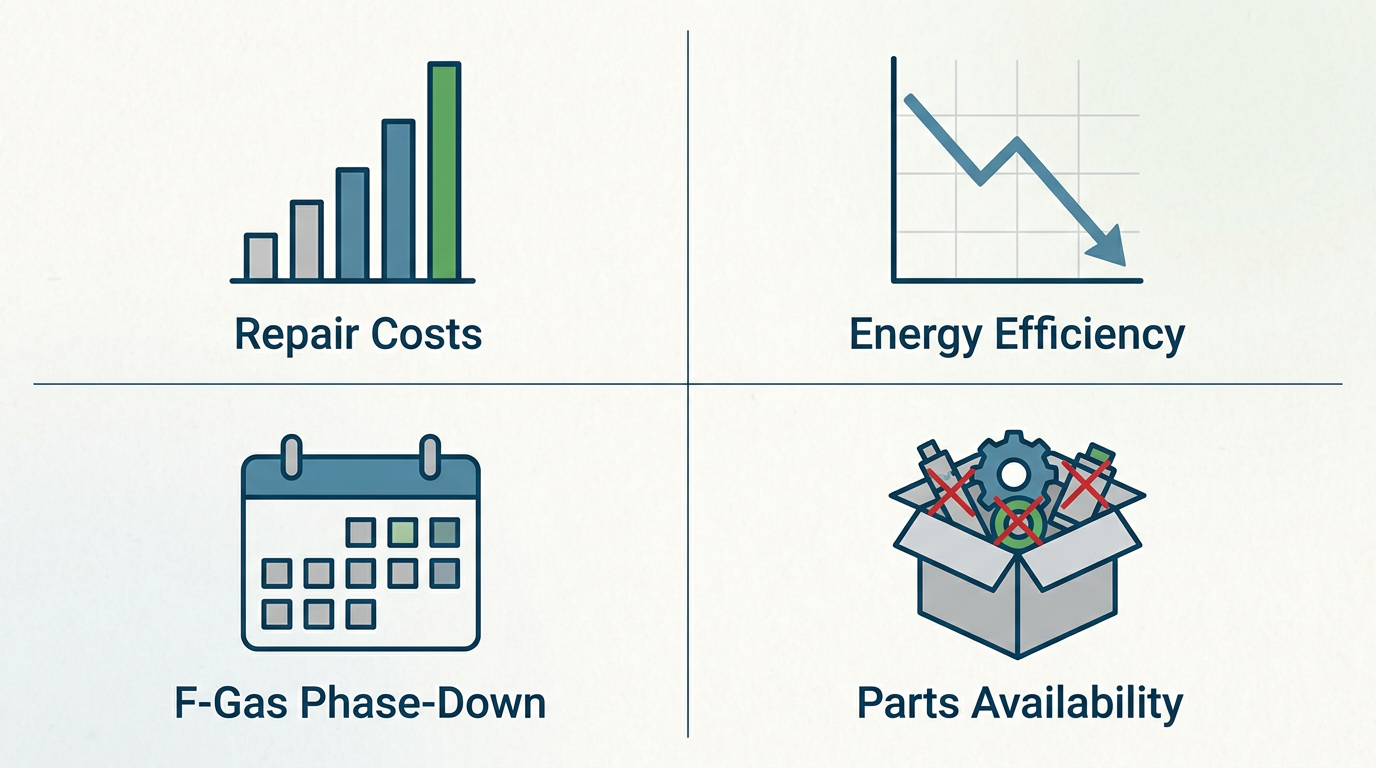
A commercial air conditioning system is at its end of life when it is no longer economically or legally viable to operate and repair it. It's not a single moment, but a tipping point reached due to a combination of four main factors:
1. **Refrigerant Obsolescence:** The system uses a refrigerant (like R410A) that is being phased down under F-Gas regulations, making it expensive and difficult to source for major repairs.
2. **Economic Viability:** The cost of a single major repair or the accumulated cost of frequent smaller repairs becomes unjustifiable compared to the cost of a new, more efficient system.
3. **Performance and Efficiency:** The unit can no longer achieve its target temperatures or its energy consumption has risen significantly, negating any savings from avoiding replacement.
4. **Parts Availability:** The original manufacturer has ceased production of critical spare parts like compressors, inverter boards, or fan motors.
The refrigerant problem: Is my r410a system obsolete?
This is the biggest driver for EOL decisions right now. Under UK F-Gas regulations, there is a hard deadline of 1st January 2025, after which virgin refrigerants with a Global Warming Potential (GWP) of 2,500 or more cannot be used for servicing. That covered older gases like R404A.
However, the regulations are also phasing down the total amount of F-Gas that can be placed on the market. This directly affects common refrigerants like R410A (GWP of 2,088). Whilst you can still legally service an R410A system, the cost of the gas is rising sharply as its availability shrinks. Using reclaimed R410A is an option, but it is not a long-term solution.
If an R410A system suffers a major leak or a compressor failure, the cost and difficulty of recharging it with compliant refrigerant often makes the repair uneconomical. This is a clear signal that the asset is at the end of its practical life, even if it could technically be fixed.
Repair vs. replace: When does it stop making financial sense?
Every asset has a point where it's no longer worth fixing. For HVAC, this manifests in two ways: a single, catastrophic failure or a 'death by a thousand cuts'.
The catastrophic failure is simple. If a VRV system's main compressor fails, the cost of the part and the labour to replace it can easily approach half the cost of a brand new, more efficient outdoor unit. At that point, investing a large sum into a 15-year-old chassis with other ageing components is a poor financial decision.
The second scenario involves tracking repeat call-outs. If a unit needs a new fan motor one year, a sensor the next, and constant refrigerant top-ups, the operational expenditure (OpEx) adds up. You are spending significant money just to keep an unreliable and inefficient system barely functional. Formal service reports and a proper asset register are essential for tracking these costs and identifying a trend.
What are the other signs a system is on its last legs?
Beyond gas and cost, the system itself will tell you when it's struggling. A key indicator is a loss of performance. If offices are complaining they can't get the space below 24°C on a warm day, or the system takes hours to reach its setpoint, it's a clear sign of degradation in the refrigeration circuit or compressor capacity.
Increased energy consumption is another major factor. A system can be 'working' but drawing far more power than it should. This is something often flagged during a TM44 air conditioning inspection, which analyses the system's efficiency. If your energy bills are creeping up without a change in usage patterns, your ageing AC is often the culprit.
Finally, listen to the equipment. Increased noise, whether it's rattling from fan assemblies or the tell-tale grinding and groaning of a struggling compressor, is a physical sign that mechanical components are worn and approaching failure.
How we handle this at Accutemp
We don't make a judgement based on age alone. We provide clients with a detailed asset condition report to help them make an informed decision. One of the first things our REFCOM-certified engineers do is connect manufacturer-level diagnostic tools to the system's board.
This lets us see data you can't get from a standard service. For instance, we can check the precise running hours on the compressors. We recently diagnosed a 12-year-old VRV system in London where the compressors had logged over 80,000 hours. To put that in perspective, it's the operational equivalent of a car with well over a million miles on the clock. Whilst it was still 'working', we could show the client clear evidence that a failure wasn't a matter of 'if', but 'when', allowing them to plan for replacement.
We combine this with a review of the system's F-Gas logbook. A history of repeated, small refrigerant top-ups is a red flag. It points to numerous micro-leaks in ageing pipework or coils, which are virtually impossible to fix economically. This evidence-based approach helps our clients build a solid business case for capital expenditure.
What to do next
Don't wait for a total breakdown to decide a system is at its end of life. The best approach is proactive assessment and strategic planning, especially for any business-critical systems over 10 years old.
A professional condition report will assess your system against all these EOL criteria, giving you a clear picture of its health and a timeline for planning its replacement. This avoids emergency expenditure and allows you to budget for new, more energy-efficient systems that will lower your running costs and ensure your compliance with F-Gas regulations.