Written by James, who carries out maintenance visits and diagnostics day to day.
You've scheduled your building's planned preventative maintenance (PPM), the engineer arrives on site, and a couple of hours later you get a service report. But what actually happens during that visit? How can you be sure you're getting a thorough, valuable service rather than a quick 'filter-and-flee' job?
Understanding the key tasks involved in a professional HVAC service is essential for any facilities manager or landlord. It allows you to verify the quality of work, ensure compliance, and appreciate how proper maintenance contributes directly to system lifespan, energy efficiency, and the comfort of your building's occupants.
A commercial air conditioning service is a systematic inspection, cleaning, and testing process covering both the indoor fan coil units (FCUs) and the outdoor condenser units. At its core, the engineer is checking for correct and efficient operation whilst cleaning components that are critical for performance.
During the visit, the engineer will methodically clean filters and coils, clear condensate drains, test controls, and inspect electrical connections. For the outdoor unit, they will clean the condenser coil and check for signs of damage or refrigerant leaks. If the system's size legally requires it, a formal F-Gas leak check will also be performed. All actions, findings, and recommendations are then recorded on a detailed service report for your records.
What are the checks for the indoor units?
The indoor units are responsible for circulating and cooling the air within a space. A service visit focuses on ensuring they can do this with maximum airflow and efficiency.
Key tasks include:
Filters: Inspecting, cleaning, or replacing the air filters is the first job. Clogged filters are the most common cause of reduced performance, forcing the fan motor to work harder and use more energy for less result.
Coils and Fins: The indoor evaporator coil is inspected and cleaned. A buildup of dust and grime on this coil insulates it, drastically reducing its ability to absorb heat from the air.
Condensate System: The engineer will check the condensate drain pan and flush the drain line to ensure it is clear. A blocked drain is a frequent cause of water leaks, which can lead to significant property damage, business disruption, and system shutdowns.
Controls and Electrics: The local controller (wall-pad or remote) is tested for correct operation. The engineer will also access the unit to check that electrical connections are tight and secure.
What happens at the outdoor condenser units?
The outdoor unit is the engine of the system, responsible for expelling the heat gathered from inside. Its location means it is exposed to the elements, dust, and debris, making regular checks vital.
A typical service involves:
Condenser Coil Cleaning: The large external coil is cleaned, usually with a chemical cleaner and a low-pressure water rinse. This is critical. A condenser coil clogged with leaves, pollen, and urban grime cannot dissipate heat effectively, causing system pressures to rise, increasing electricity consumption, and putting strain on the compressor.
Visual Inspection: The engineer will visually inspect the unit for any signs of physical damage, corrosion, or vibration. They specifically look at the refrigeration pipework for any oil staining, which is a tell-tale sign of a potential refrigerant leak.
Fan and Motor: The condenser fan blades and motor are checked for integrity and to ensure they run freely without any signs of bearing wear.
What about compliance and performance testing?
A proper service goes beyond just cleaning. The engineer will perform tests to verify performance and ensure you remain legally compliant.
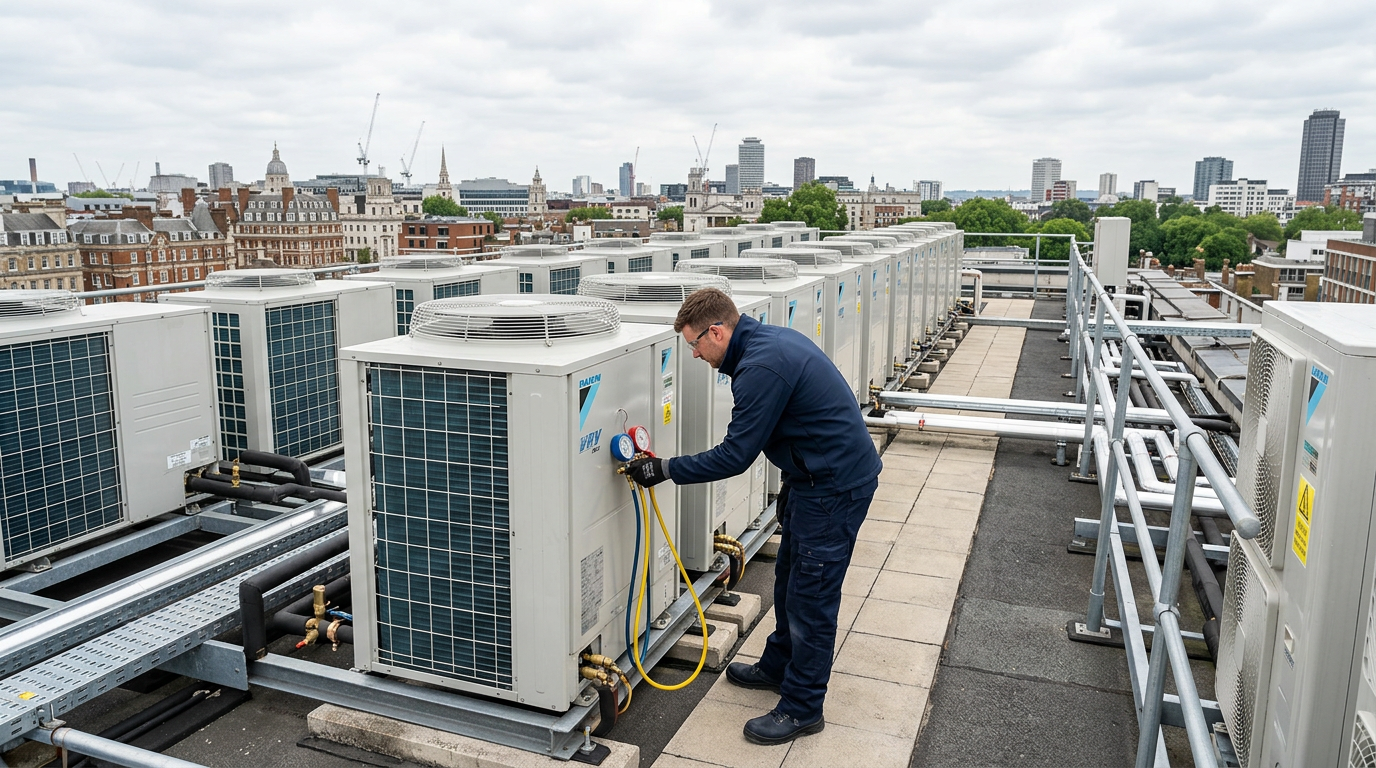
First, the engineer will run the system in both cooling and heating modes to check it functions correctly. They will often attach gauges to measure refrigerant operating pressures and use probes to check air temperatures, comparing these readings against the manufacturer's expected data for the ambient conditions. This can reveal underlying issues that aren't yet causing a full-blown failure.
If your system contains F-Gas refrigerant equivalent to 5 tonnes of CO2 or more, a mandatory leak check is legally required at set intervals. Your service engineer must be F-Gas certified and use a calibrated electronic leak detector to inspect the system. This is a distinct, legally-required task, though it is usually performed during a PPM visit. All findings must be recorded in your F-Gas logbook.
Finally, all of this is documented on a digital service sheet, providing a record of work done, asset condition, and any recommendations for repairs. This report is your proof of maintenance and essential for any compliance audit.
How we handle this at Accutemp
We operate from a standardised digital checklist that contains over 30 individual points for a typical VRF/VRV system service. This ensures a consistent and thorough job every time, regardless of which engineer attends the site. It removes guesswork and makes the entire process auditable.
One thing we often see when taking over a new contract is evidence of 'pencilling' on old paper service sheets, where every box has been ticked with minimal effort. To combat this, our digital reports require the engineer to submit photographs for key tasks. For example, we mandate 'before' and 'after' photos of the filters and condenser coils. This provides the client with clear, indisputable evidence of the work carried out and the value delivered during the visit.
As a REFCOM Elite and Constructionline Gold accredited company, all our documentation is designed for audit readiness, giving you traceable records for F-Gas regulations, ISO 14001 environmental audits, or internal compliance checks.
What to do next
A thorough service visit is an investment in reliability and efficiency, not just a recurring cost. The difference between a comprehensive PPM programme and a superficial check can mean thousands of pounds in avoided energy waste and premature component failure.
Review your latest service reports. Do they give you the detail and confidence you need? If you're concerned about the quality of your current maintenance regime or need to establish a new PPM schedule for your property portfolio, speak to our team.