Written by Amrit, who has spent over a decade working across commercial AC and compliance.
As a facilities manager or landlord, you are responsible for a large amount of compliance paperwork. One item that often causes confusion is the TM44 air conditioning energy assessment, sometimes just called a 'TM44'.
It can be unclear what the inspection covers, whether it’s mandatory for your site, and what you’re supposed to do with the report afterwards. Understanding your obligations is key to avoiding penalties and ensuring your building is operating efficiently.
Yes, if your commercial building has air conditioning systems with a combined effective rated output of more than 12kW, you are legally required to have a TM44 inspection completed every five years. This applies to the entire building's inventory of systems, not just a single unit.
The purpose of the inspection, which must be carried out by an accredited energy assessor, is to evaluate the energy efficiency of your AC equipment. The final report provides recommendations to reduce your energy consumption, carbon emissions, and operational costs.
What counts towards the 12kw threshold?
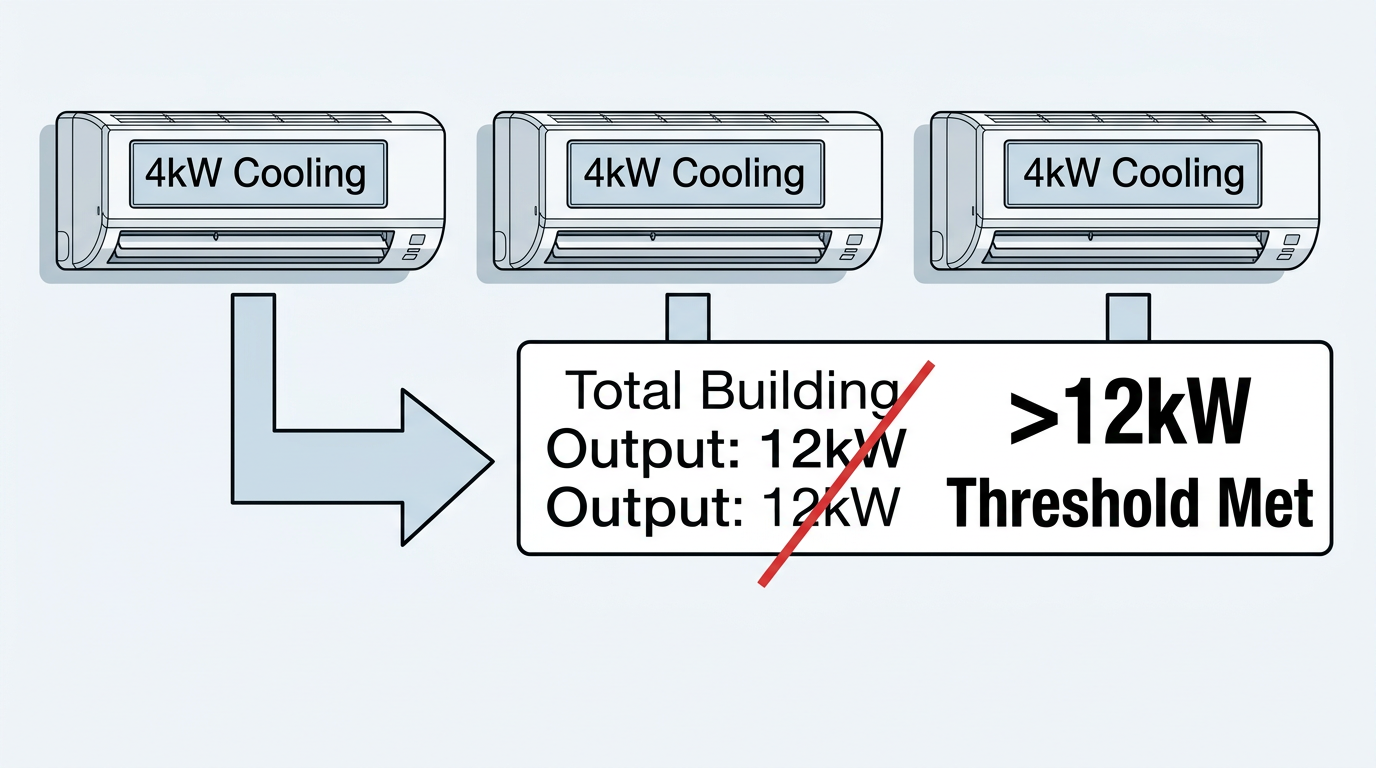
The 12kW threshold is a common point of misunderstanding. It refers to the *total cooling capacity* of all individual air conditioning units within a building, not the power they draw from the wall. A single large VRF/VRV system on a roof will almost certainly exceed this.
Crucially, a collection of smaller, separate systems also counts. For example, if your office has five individual 3kW split systems, your building's total effective output is 15kW. This places you over the 12kW threshold and makes a TM44 inspection a legal requirement.
What actually happens during a TM44 inspection visit?
A TM44 inspection is a visual assessment and a review of documentation. The accredited assessor does not perform any physical work on the equipment, unlike a maintenance engineer. Their job is to build a picture of your system's overall efficiency.
The assessor will typically examine a representative sample of your AC units, looking at their age, type, and condition. They will review your control strategies, operating times, and any available documentation, including F-Gas logbooks and maintenance records. The goal is to judge how well the system is designed, sized, installed, and maintained for its purpose.
What is in the final TM44 report?
The inspection does not result in a 'pass' or 'fail'. Instead, you receive a detailed report that must be lodged on the government's national register. This document contains key information about your equipment's efficiency and a list of recommendations for improvement.
These recommendations can range from simple, low-cost actions (like adjusting thermostat settings or improving maintenance practices) to more significant investments (like upgrading controls or planning for system replacement). Whilst you are not legally obligated to act on these recommendations, doing so can lead to significant energy savings and operational improvements. The certificate is a requirement for compliance audits and may be requested by tenants or during the sale of a building.
How we handle this at Accutemp
Our TM44 assessors are also experienced HVAC engineers. This means we don't just see the system from a theoretical energy perspective; we see it through the lens of real-world performance and maintenance. This dual expertise makes our reports more practical.
A common thing we see is a disconnect between the TM44 report and the actual maintenance plan. A typical report might vaguely suggest 'Improve maintenance regime'. Our reports are more specific. For example, we recently noted on a client's TM44: 'The assessor observed that the F-Gas logbook had not been updated in 18 months, which is a legal breach and prevents accurate efficiency tracking. Recommendation: Reinstate mandatory quarterly leak checks and servicing as per F-Gas regulations.' This gives a facilities manager a concrete, actionable item tied directly to both compliance and efficiency, making it easier to justify the necessary action.
What to do next
Your first step should be to locate your current TM44 certificate and check its expiry date. If you cannot find one, or if it is more than five years old, you will need to arrange a new inspection to remain compliant.
Having a valid TM44 report is not just a legal formality; it's a valuable tool for managing your building's energy consumption and carbon footprint effectively.