Written by Amrit, who has spent over a decade working across commercial AC and compliance.
If you operate a commercial building with air conditioning or refrigeration, you may be subject to an F-Gas audit from the Environment Agency or another UK regulatory body. What exactly does this involve, and what happens if your records are not up to scratch? It is a question many facilities managers only ask when it is too late.
Failing an audit is not just about a potential fine; it can involve enforcement notices and significant disruption. Getting your house in order is not difficult, but it does require a clear process and accurate record-keeping. Knowing what an inspector looks for is the first step to being prepared.
An F-Gas audit is a formal inspection to verify that you, the 'operator', are meeting your legal duties under the UK F-Gas Regulation. An inspector will examine your records to ensure all equipment containing fluorinated greenhouse gases is being managed correctly. This means proving that you have systems in place to prevent leaks and that any work is carried out by qualified personnel.
To prepare, you must have a complete and up-to-date F-Gas logbook for all relevant assets. This logbook needs to be supported by service sheets from your maintenance provider, demonstrating that leak checks are being performed at the correct frequency and that any refrigerant added or removed has been properly accounted for. Crucially, all work must have been done by an F-Gas certified engineer from a REFCOM-registered company.
Who is legally responsible for f-gas compliance?
The regulations place the legal duty on the 'operator' of the equipment. This is a key definition. The operator is the person or organisation with actual power over the technical functioning of the system. This is frequently the building owner or landlord, but lease agreements can pass this responsibility to the tenant. If you manage a multi-tenanted building, this needs to be explicitly clear in your lease agreements.
It is not your maintenance contractor. Whilst your contractor has a duty to perform the work correctly and provide you with the right paperwork, the ultimate legal responsibility for maintaining the F-Gas register and ensuring compliance rests with the operator.
What specific records will an auditor want to see?
An auditor is looking for a complete, unbroken chain of evidence. They will typically request the following documents for your stationary refrigeration, air conditioning and heat pump (SRAC) equipment:
• An asset register listing all equipment containing F-Gas, including its location, type, and the quantity of refrigerant it contains.
• The F-Gas logbook(s) for all assets, showing a full history of service, maintenance, and leak checks.
• Records of scheduled leak checks, proving they are done at the required frequency (determined by the system’s CO2 equivalent tonnage).
• Documentation for any refrigerant top-ups or recovery, including the quantity in kilograms and the reason for the action.
• The full details of the company and engineer who performed the work, including their REFCOM certification credentials. An invoice is not enough; you need the service report.
What are the common failure points during an audit?
The most common failure is an incomplete or missing F-Gas logbook. This single document is the backbone of your compliance. Another frequent issue is a mismatch between the logbook and the engineer’s service reports. Dates might be wrong, refrigerant quantities might not add up, or details about a leak repair might be vague.
Auditors also look for evidence that you are using properly certified engineers. If the service sheets lack a REFCOM number for the company or a personal F-Gas ID for the engineer, it immediately raises a red flag. Finally, simply not knowing which equipment on your site contains F-Gas is a sign of poor management that an auditor will pick up on immediately.
How we handle this at Accutemp to keep clients audit-ready
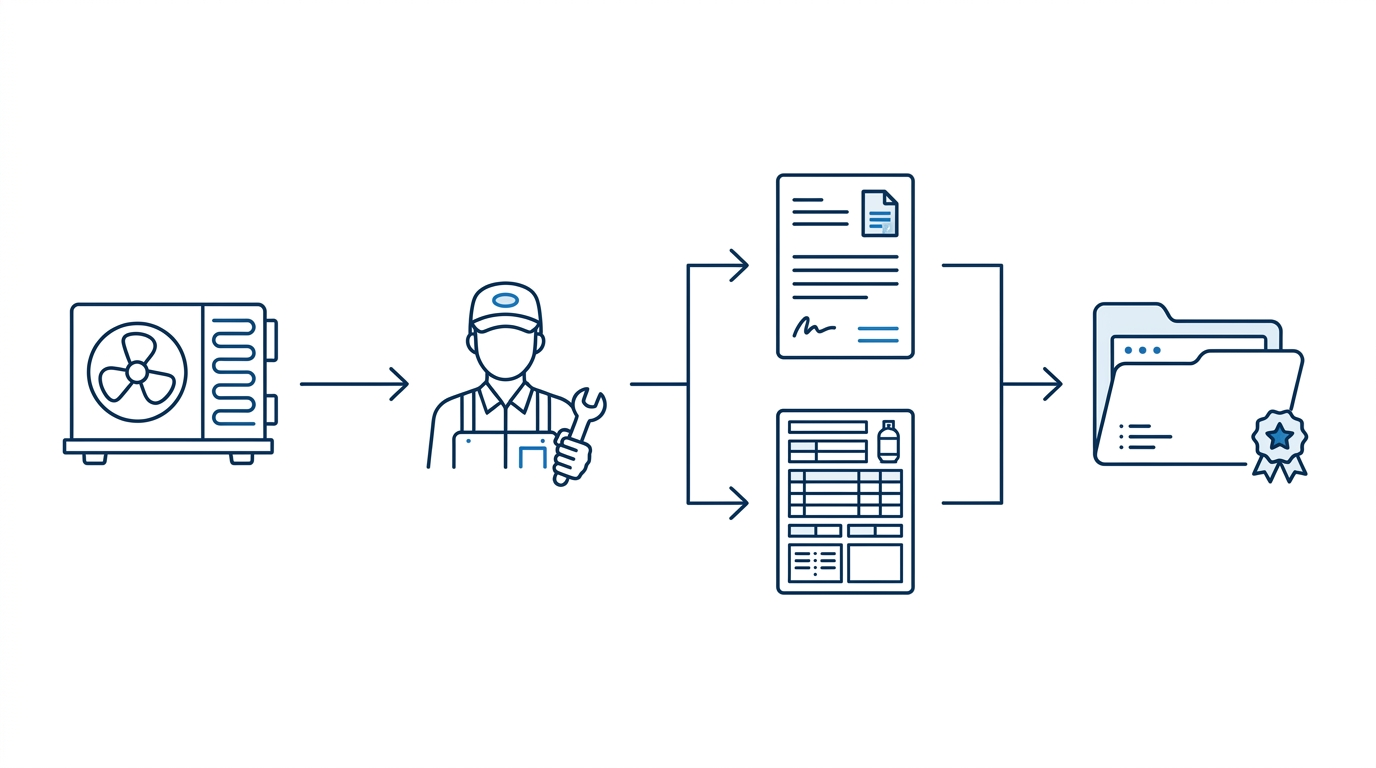
We find the most common point of failure for clients is simply finding the paperwork. That is why after every maintenance or repair visit, we provide a digital service report and an updated F-Gas logbook directly to the client within 48 hours. There is no six-week wait for paperwork to be processed, which means their compliance file is always current.
For any new client, the very first step in our planned preventative maintenance (PPM) contract is a comprehensive asset and F-Gas survey. We locate, identify, and tag every single applicable unit. We then calculate the CO2 equivalent for each system to establish the correct leak testing schedule. This creates a definitive asset register from day one, which is the foundation of being audit-ready. It removes the guesswork and ensures nothing is missed.
What to do next
Take a moment and ask yourself: if an Environment Agency inspector called tomorrow, could you locate your F-Gas logbook in under five minutes? Would it be fully up-to-date, reflecting the last service visit?
If the answer is no, or if you are not confident in your records, it is time to act. A reputable, REFCOM-accredited provider can carry out a full site survey to establish a compliant baseline, create a proper asset register, and ensure your legal obligations are being met.