Written by James, who carries out maintenance visits and diagnostics day to day.
Staff complaints about uneven temperatures are a familiar problem for any facilities manager. The finance department is freezing under a vent, whilst the sales team across the hall is overheating. This isn't just a minor annoyance; it affects staff productivity and often points to an underlying inefficiency or fault in your building's air conditioning system.
Ignoring these symptoms can lead to higher energy bills, increased wear on expensive components, and eventually, a more significant failure. Understanding the potential causes is the first step to getting the problem properly diagnosed and resolved.
Uneven heating and cooling in a commercial space is rarely due to a simple fix. It is a symptom of a deeper issue. The most common causes are incorrect controller settings causing systems to 'fight' each other, poorly placed temperature sensors giving false readings, airflow blockages, or a specific component failure within a more complex VRF or VRV system.
Essentially, the system is no longer balanced. This could be a legacy from a poor initial installation, or a fault that has developed over time. It requires a methodical diagnostic process, not just adjusting the thermostats.
Is it a problem with the system controls or sensors?
Before assuming a major mechanical fault, the first area to investigate is the control system. In many offices, multiple indoor units are wired to a single master controller. If individual user controllers are also in play, it is easy for settings to conflict. We often find systems where one unit has been set to 'heat' whilst another is in 'cool' mode, causing the overall system to behave erratically.
Sensor placement is another frequent culprit. A thermostat placed in direct sunlight, next to a hot photocopier, or directly in the cold draught of a diffuser will send entirely inaccurate information back to the central controller. The system then works overtime to cool a 'hot' spot that isn't actually hot, or vice versa. This effectively de-calibrates the comfort of an entire zone based on one faulty reading.
Could it be an airflow or balancing issue?
Even with a perfectly functioning system, if the conditioned air cannot get where it needs to go, you will have problems. The most basic check is for physical obstructions. Over the years, office layouts change. A new partition wall or a tall filing cabinet placed in front of an air grille can completely disrupt the airflow in a room, creating stagnant hot spots.
Dirty filters are another primary cause of reduced airflow. A clogged filter in one indoor unit means it cannot deliver its share of cooling or heating, forcing other units in the same zone to work harder and creating an imbalance. On ducted systems, dampers may have been incorrectly set during installation or tampered with since, meaning the air distribution is not balanced correctly across the floor.
What are the common faults in VRV or VRF systems?
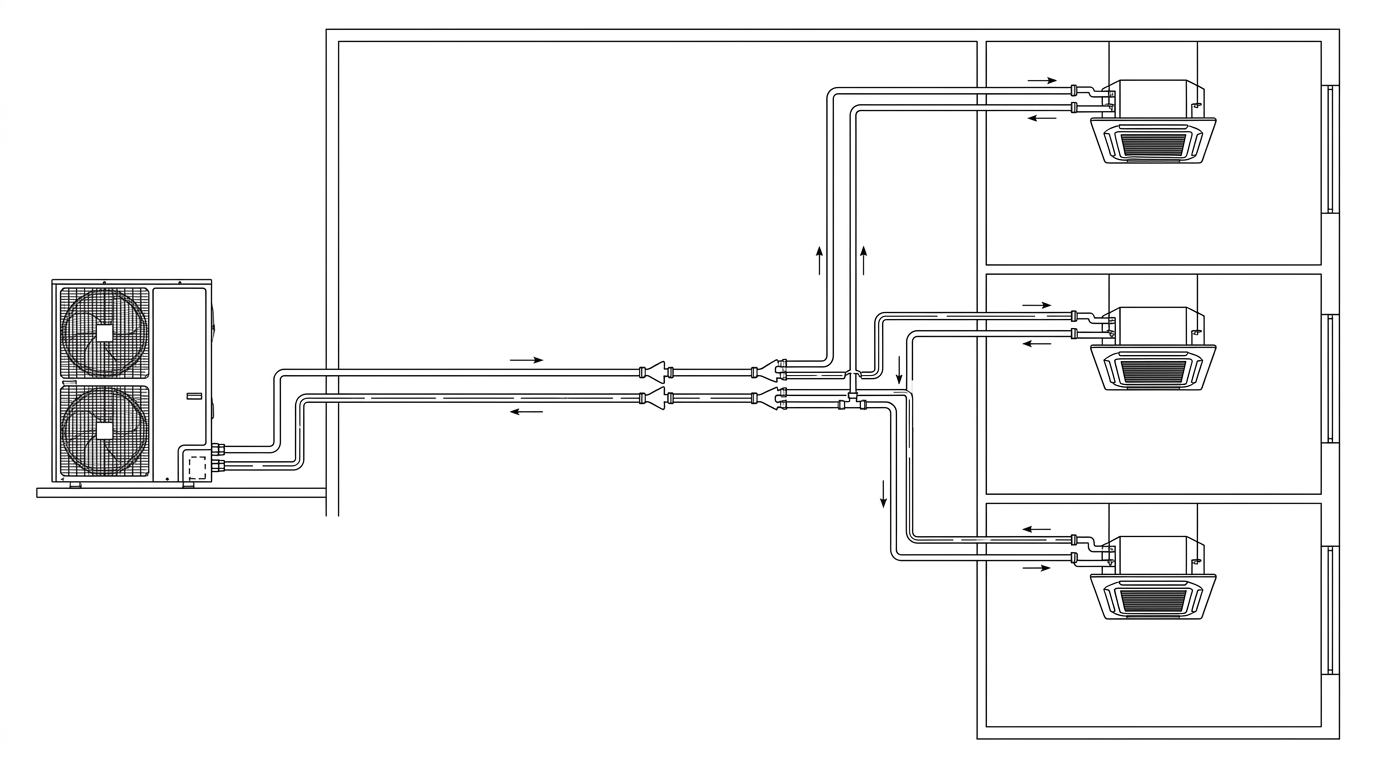
Modern offices frequently use VRF (Variable Refrigerant Flow) or VRV (Variable Refrigerant Volume) systems. These are highly efficient but also far more complex than simple split systems. They use a network of pipes and valves to deliver precise amounts of refrigerant to many individual indoor units.
A common failure point is an individual unit's electronic expansion valve (EEV). This component regulates the flow of refrigerant into the unit. If it sticks open, it will flood the unit with refrigerant, causing it to over-cool and freeze the occupants. If it sticks closed, the unit will deliver no cooling at all, leading to a hot spot. Other issues, such as a gradual loss of refrigerant charge or a communication error between an indoor unit and the outdoor condenser, can also create uneven performance across the building. These faults require specialist diagnostic equipment to identify correctly.
How we handle this at Accutemp
When we attend a site with reports of uneven temperatures, we do not start by guessing. Our first step is to connect manufacturer-level diagnostic tools (like a Daikin Service Checker or Mitsubishi AG-150A) directly to the outdoor unit's circuit board. This gives us a complete operational view of the entire system.
This tool allows us to see real-time data for every single component. For instance, we can poll the opening percentage of the electronic expansion valve (EEV) for the 'freezing' office and compare it to the valve in the 'hot' office. If one reads 90% open and the other is stuck at 5%, whilst the room sensors report similar temperatures, we have found our fault. This diagnostic check takes minutes and pinpoints the exact component, saving hours of labour and preventing the unnecessary replacement of parts.
This process provides hard data for our service reports, ensuring our work is transparent and that your building's records are always ready for an F-Gas audit or review.
What to do next
Hot and cold spots are a symptom that should be properly investigated by a qualified engineer. Allowing untrained personnel to tamper with controllers or system components on a commercial VRF system can often introduce new faults and make the situation worse.
The correct course of action is to book a diagnostic visit from a REFCOM-certified firm with proven experience on the specific make of your system. A methodical approach based on data is the only way to guarantee a permanent fix.